
Garage Insulation Dallas: Why the Hottest Room in Your House Is Costing You Money All Year
Meta description: Improve comfort in your Dallas home with garage insulation focused on air sealing the shared wall, ceiling and bonus-room floor, not just the garage door.
Suggested URL slug: /garage-insulation-dallas-texas/
In a 105-degree Dallas afternoon, a west-facing garage door in full sun can turn the garage into an oven. The heat does not stay put: it moves through the shared wall, ceiling and floor beneath a bonus room. Thoughtful garage insulation starts by protecting the boundary between the garage and your conditioned home, not by treating the whole garage like a living room.
Why garage insulation matters more in Dallas-Fort Worth than most homeowners expect
A garage is easy to overlook because it is not air-conditioned. But heat absorbed by its door and walls makes nearby living spaces harder to keep comfortable, and the fix is not to treat the garage like a living room. It is to seal and insulate the surfaces that separate it from the house.
The wall you share with your garage is an exterior wall
The U.S. Department of Energy’s Building America Solution Center notes that walls and ceilings between an attached garage and conditioned rooms are part of the home’s building thermal envelope, and builders often overlook them because the garage itself is unconditioned. An incomplete barrier lets heat and garage air move toward living areas. See the DOE guide to air sealing an attached garage.
The bonus room over the garage problem
In two-story plans common around Frisco, Prosper and Celina, the garage ceiling is also the floor beneath a bonus room. If that room is always too hot or cold, the cause may be gaps in the floor assembly, thin or displaced insulation, or leaky ductwork, not a thermostat setting. The University of Minnesota Extension’s bonus-room energy guide makes the same point.

The safety side of garage insulation nobody mentions
Comfort matters, but this barrier is also about safety. Drywall between the garage and living space provides fire separation, typically 1/2-inch Type X gypsum where local fire code requires it. Drywall alone is not air sealing, though. Seams, penetrations and framing gaps still need attention.
The door between the garage and house should be treated like an exterior door: choose a solid-core or insulated-metal, fire-rated door with weatherstripping, a tight-fitting threshold sweep and self-closing hardware.
There should be no supply or return registers in the garage. If an air handler or furnace is located there, it should sit inside an air-sealed closet; a garage furnace is best specified as sealed-combustion/direct-vent. Gas water heaters and furnaces need adequate combustion air. Sealing a garage too tightly without checking these appliances can create backdrafting risks. Have a qualified professional inspect the equipment and install functioning carbon monoxide alarms.
Where the heat and the money actually leak
During an assessment, check these five locations:
- Open joist bays: Bays that run from above the garage into the house can create a direct air pathway. Block them with rigid material and seal the edges.
- Rim joist and top plate: Caulk or foam gaps at the rim joist, top plate, sill plate and foundation junctions.
- Shared wall: Seal joints and penetrations before adding insulation.
- Ceiling above the garage: the floor assembly for any room above; gaps hurt comfort and allow air movement.
- Garage door itself: a single-panel, uninsulated steel door may be roughly R-0 to R-2. A DIY kit may add around R-2 to R-8, but insulating the door alone has limited benefit if the ceiling and shared wall stay leaky.
What garage insulation done right looks like
The aim is not to condition every corner of the garage. It is to make the separation between garage and home a continuous, sealed, well-insulated boundary.
Seal the shared wall and ceiling first
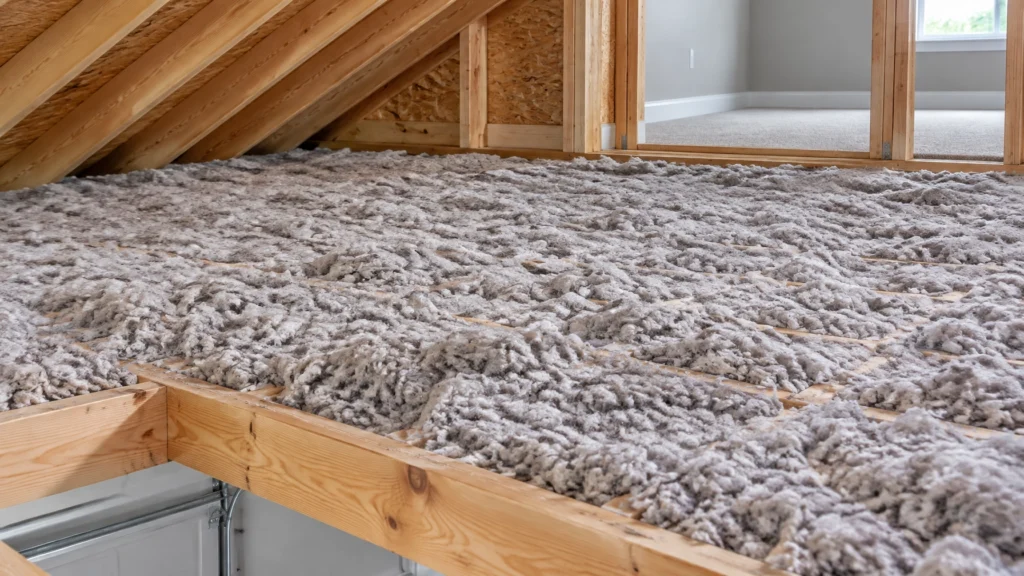
Start by closing open joist bays with rigid blocking and sealing the edges. Caulk or foam gaps around the rim joist, top plate, sill plate, foundation and utility penetrations. For many assemblies, a “flash and batt” approach applies roughly 2 inches of closed-cell spray foam to air-seal the shared wall or ceiling, then adds fibrous insulation, blown-in or batts, to reach the project’s target. Ceiling insulation should be covered by taped and mudded drywall. The DOE code-compliance brief describes the importance of sealing these garage boundaries.
Insulate the floor above the garage to the right R-value
A floor above a garage is treated as a floor, not a ceiling, for code purposes. As a preliminary reference, the 2021 IECC’s Climate Zone 3 targets are approximately R-49 ceilings, R-19 floors and R-20 wood-frame walls (or R-13 plus R-5 continuous). Local jurisdictions amend code, so confirm the target during your assessment.
Ductwork and plumbing in the ceiling that serves the room above should be sealed and insulated too; leaky ducts are a common reason a bonus room never catches up.

Then think about the garage door and the exterior walls
After the shared wall and ceiling, consider whether the garage door needs insulation or better weather seals. A west-facing door in Fort Worth absorbs strong afternoon sun, but a door upgrade works best as part of a complete plan. Exterior garage walls are worth insulating if the garage doubles as a workshop.

How garage insulation fits into a whole-home plan
Garage work pairs well with attic and air-sealing improvements; sealing one boundary while leaving major leaks elsewhere rarely fixes uneven temperatures. Our team can assess the garage assembly alongside attic insulation, spray foam and blown-in insulation. Each material has a role, depending on access, framing and the work planned. If your attic is overdue as well, our guide to attic insulation before a North Texas winter walks through the same ceiling-plane details.
Whether you are upgrading an older home in Garland, Arlington or Irving, or planning new construction in Plano or McKinney, the details decide the result. Excellence Home Insulation has 15+ years of experience and more than 2,500 completed projects, and our BPI-certified installers provide same-day assessments with tailored recommendations. If you are weighing energy efficient insulation Dallas upgrades, a clear assessment will show whether the garage boundary is part of the problem.
Frequently asked questions
Will insulating my garage make my house cooler?
It can, especially if the shared wall or floor above the garage is poorly insulated or air-sealed. Results depend on the rest of the home’s assembly.
Should I insulate the garage walls or just the ceiling?
Prioritize the surfaces that border conditioned rooms: the shared wall and the ceiling above. The right scope depends on the garage layout and existing insulation.
Can I just insulate the garage door and be done?
Usually not. A door kit improves the door, but it will not seal open joist bays, the shared wall or the ceiling above the garage.
Is it safe to seal up a garage that has a gas water heater in it?
Have the appliance and its combustion-air supply checked before tightening the boundary, and install working CO alarms.
Request your free garage insulation estimate in DFW
The right garage insulation plan starts with a careful look at the actual thermal boundary, air pathways, appliance setup and code requirements, not a one-size-fits-all package. Request a free assessment from our BPI-certified installers. We offer same-day assessments in Dallas, Fort Worth, Frisco, McKinney, Plano, Allen, Prosper, Celina, Denton, Arlington, Garland, Irving and throughout the surrounding Metroplex. Contact Excellence Home Insulation to request your free estimate or call (972) 552-0200.


